
In performance marketing, deliberately removing your cheapest source of conversions can seem counterintuitive. If a placement is delivering volume at a low cost per acquisition, why would you switch it off?
The answer is that a cheap conversion is only valuable if it leads to a good customer outcome.
Acquisition metrics tell us what happened at the beginning of the customer journey. They do not necessarily show what happened afterwards. A campaign can deliver an attractive CPA while also generating complaints, accidental subscriptions, rapid cancellations or customers who never produce sustainable revenue.
This creates a difficult question for advertisers: are the campaigns producing valuable customers, or simply inexpensive conversions?
Looking beyond the advertising platform
This question was at the centre of a recent webinar initiated by Christopher Henseler, Co-Founder of Mesh Ads.
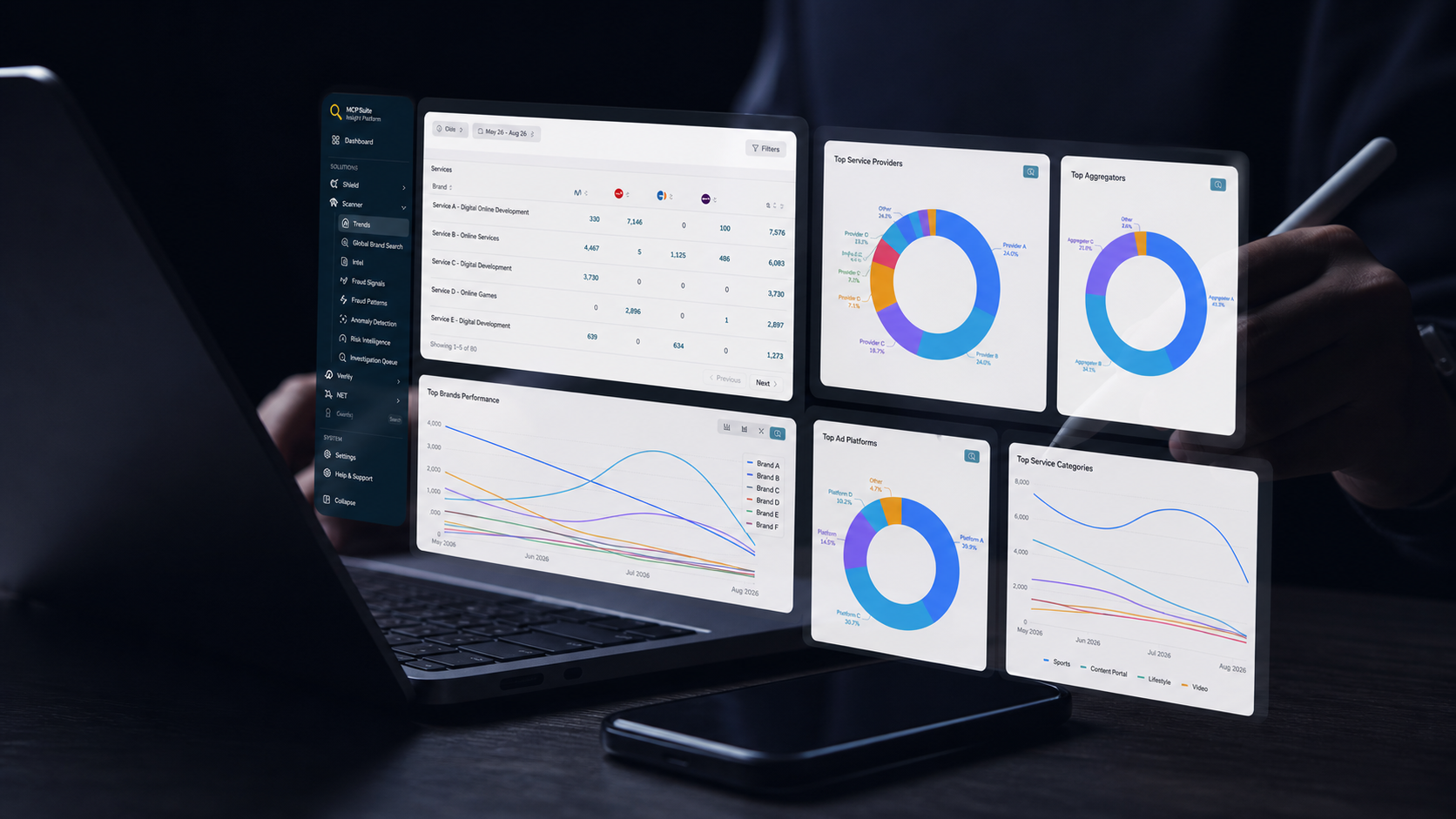
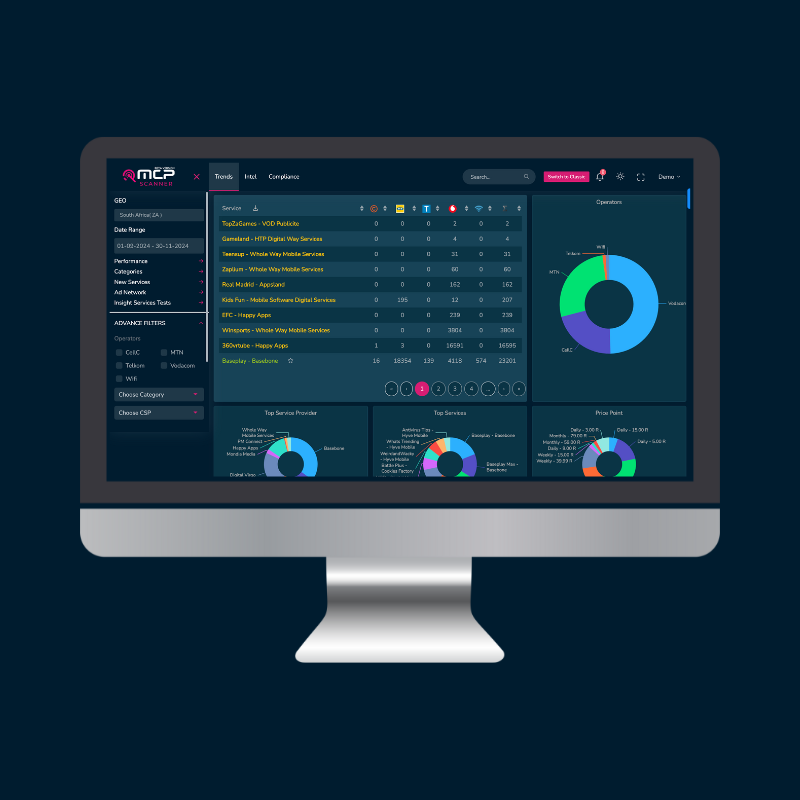
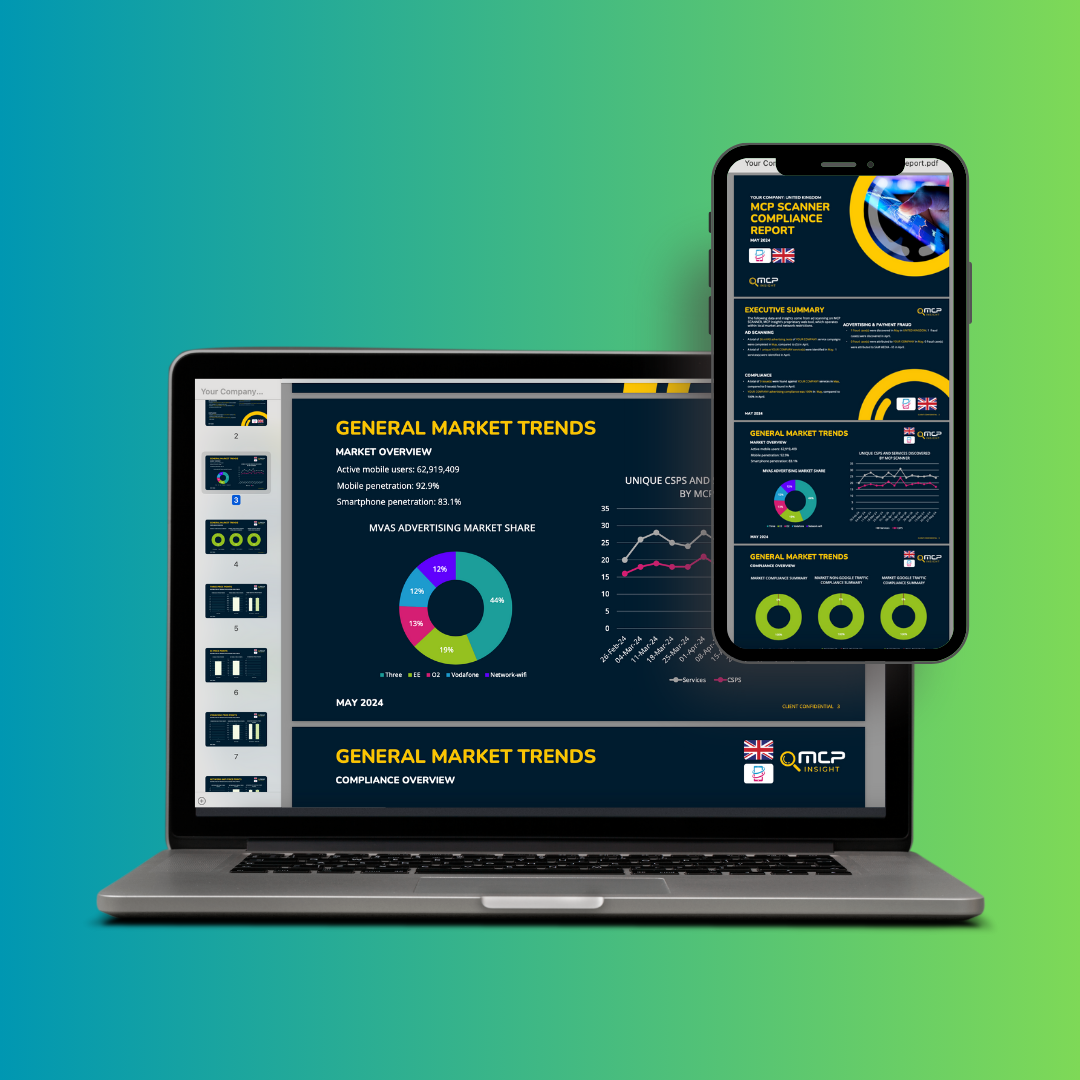
Mesh Ads specialises in managing compliant, high-performance Google Ads campaigns in regulated sectors. Its team uses its own technology, campaign expertise and clients’ data alongside independent MCP Insight data to understand what happens beyond the initial conversion.
That broader view matters because advertising platforms are designed to optimise against the signals available to them. They can identify which campaigns, adverts and placements generate clicks and conversions. However, they may not have visibility of later customer outcomes across the market.
By bringing together campaign performance and independent market intelligence, Mesh Ads can examine whether apparently successful traffic is also associated with poor-quality outcomes.
The cheapest traffic was creating the greatest risk
During the webinar, Chris shared an anonymised example from a live client campaign.
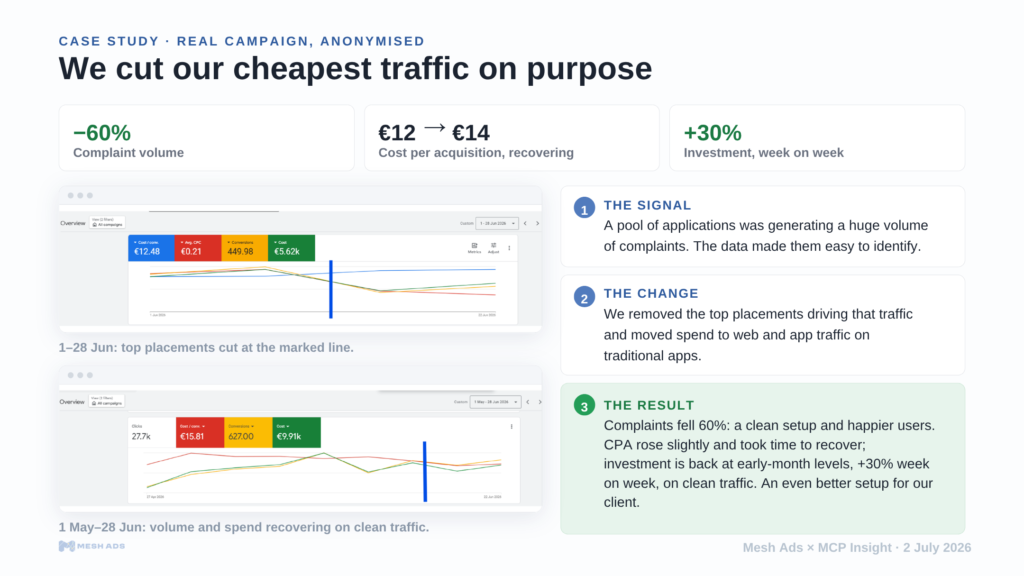
A group of applications was delivering a substantial volume of conversions at an attractive CPA. Viewed through the advertising platform alone, these placements appeared to be performing well.
MCP data and Mesh Ad’s client data revealed another part of the picture: the same traffic was associated with a disproportionately high volume of consumer complaints.
Mesh Ads made the decision to remove the placements generating that traffic and redirect investment towards web and app traffic from more established applications.
The immediate effect was predictable. CPA increased from approximately €12 to €14 as the campaign adjusted.
If CPA had been the only measure of success, this could have looked like a backward step. But the wider results told a different story:
- Complaint volumes fell by approximately 60%.
- CPA began to recover as the campaign adapted.
- Investment subsequently increased by 30% week on week.
- Spend and acquisition volume recovered on a cleaner traffic base.
The decision traded a small amount of short-term acquisition efficiency for a healthier and more sustainable campaign.
Cheap conversions can carry hidden costs
This is not an argument that low CPA is inherently bad. Efficient acquisition remains important. The problem arises when CPA is treated as a complete measure of customer value.
Poor-quality traffic can create costs elsewhere in the business, including:
- Higher complaint and customer-support volumes.
- Faster cancellation or churn.
- Refunds and chargebacks.
- Greater scrutiny from operators, payment partners and regulators.
- Damage to advertising accounts and commercial relationships.
- Lost confidence in a service or acquisition channel.
Some of these consequences appear days or weeks after the original conversion. Others are experienced by a different organisation in the value chain. The agency may see the conversion, while the service provider or operator receives the complaint and sees the effect on its customers.
That separation makes it easy to optimise one part of the journey while unintentionally weakening another.
Better optimisation starts with better questions
The lesson from the Mesh Ads example is not simply that certain placements should be removed. It is that campaign teams need access to signals that connect acquisition activity with later customer outcomes.
Before increasing spend, it is worth asking:
- Which sources generate customers who remain engaged?
- Are particular placements associated with unusual complaint patterns?
- Does a low CPA correspond with sustainable revenue?
- What happens to cancellation, refund and complaint rates when volume increases?
- Are campaign decisions improving the whole customer journey or only the first step?
These questions are relevant across the mobile payments and digital services ecosystem. Advertisers, agencies, content providers, aggregators and operators may hold different parts of the evidence. Sustainable growth depends on connecting those perspectives and acting on what the combined data shows.
In this case, Mesh Ads brought the campaign expertise, technology and judgement needed to make the change. MCP Insight provided an independent view of the market and clients reported back customer outcomes that were not visible in the advertising platform alone.
Neither source of information would have provided the complete answer independently.
Bring us a market question in Amsterdam
MCP Insight will be at Global Carrier Billing in Amsterdam on 29 and 30 September.
If you are attending, bring us a question about one of your markets, campaigns, competitors or customer journeys. We can use live MCP TRENDS data to explore what is happening and identify signals that may not be visible in your own reporting.
It might be a market where acquisition performance looks unusually strong, a source of traffic you want to understand more clearly or an emerging issue affecting customer experience and sustainable revenue.
Book a meeting with the MCP Insight team at Global Carrier Billing.